breadcrumb
Content SDK component is missing React implementation. See the developer console for more information.
INTRODUCTION
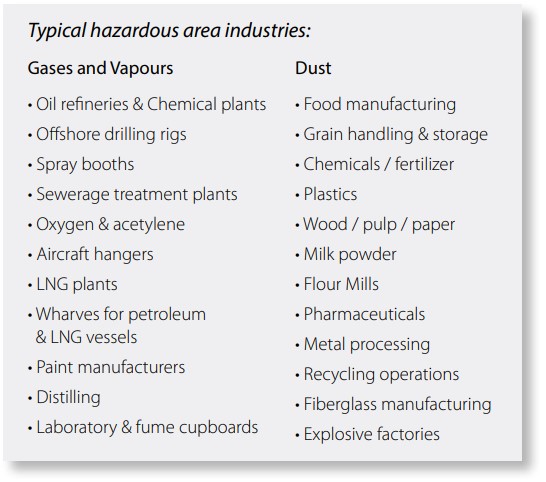
In electrical engineering, a hazardous area is defined as an environment that consists of any concentrations of flammable gases, vapours or combustible dusts. In these instances, all electrical equipment that is to be installed in such environments is specially designed and tested to meet a range of requirements that together ensure the safety of personnel and avoid potentially dangerous situations resulting from interaction between the equipment and its surroundings.
Applications that involve the processes of production, transformation, delivery and stocking of flammable substances commonly produce potentially explosive environments. Chemical and petrochemical, mining, oil and gas, food processing and grain handling all involve the use of flammable materials. When these come into contact with the oxygen in the air, they can create an explosive atmosphere. If this atmosphere is triggered, the resulting explosion can cause serious damages to people and the environment.
In the following Technical Newsletter we provide an Introductory Guide to hazardous areas in Australia and New Zealand to help those involved in Ex environments navigate the standards and regulations of relevant bodies. This document will also be useful in raising awareness of the risks surrounding hazardous areas and developing work safe practices.
SELECTION OF ELECTRICAL EQUIPMENT
In order to select electrical apparatus for use in hazardous areas it is necessary to have the following information:
- Area Classification
- Gas, vapour or combustible dust group
- The “T” rating or the ignition temperature of the hazard
- The required IP rating of the apparatus
1. Area Classification
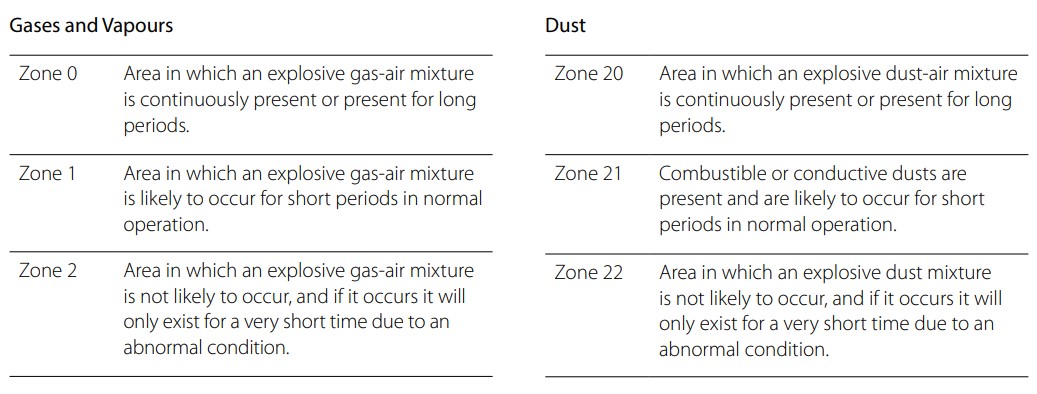
The areas are classified into ZONES, and these zones are based on the frequency of the appearance of an explosive atmosphere and the duration for which it can last.
Summarised in the table below:
2. Gas, vapour or combustible dust group
Gases and vapours are divided into three groups:
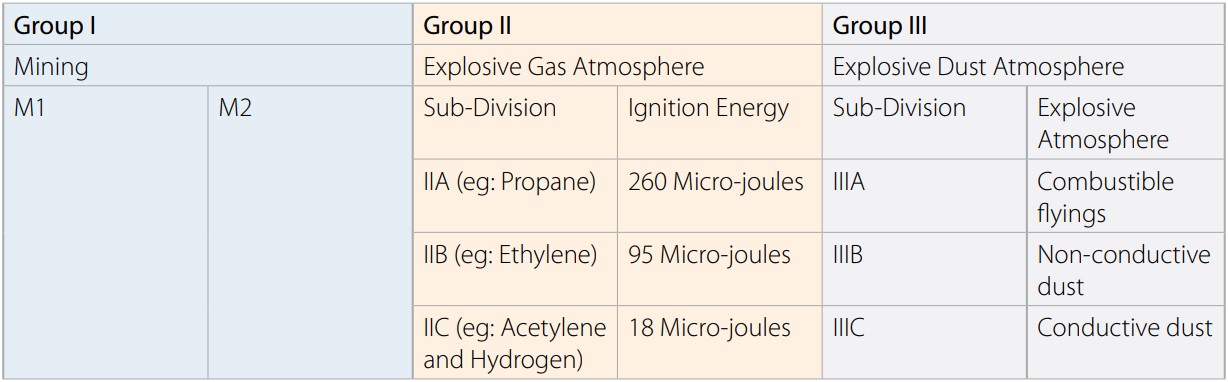
The hazard level of the gases and dusts increases from gas groups IIA to IIC and dust groups IIIA to IIIC. The most severe in both cases being IIC and IIIC.
3. Temperature or “T” rating for explosive gas atmospheres.
The source of ignition in a hazardous area can be an arc or a spark or even a hot surface.
Since electrical equipment generates heat in normal operation we need to ensure that a hot surface on electrical apparatus cannot ignite a surrounding explosive gas atmosphere or a dust cloud or layer.
All hazardous materials have what is known as an “Ignition Temperature”, this is the minimum temperature at which the hazardous material when mixed with air will ignite and sustain combustion, without an ignition source (auto-ignition or spontaneous ignition).
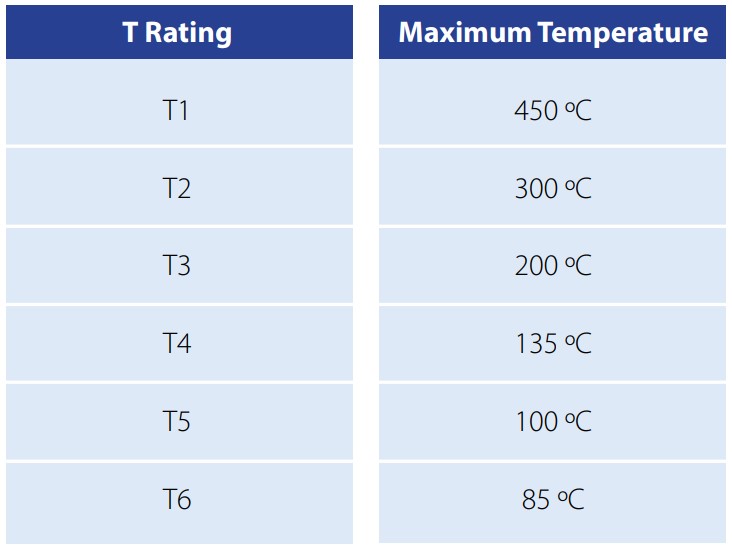
For explosive gas atmospheres a“T” rating is given. For example, a T6 rated product will not exceed 85 ºC and a T3 will not exceed 200 ºC. While in service in hazardous area equipment for explosive dust atmospheres are given a maximum surface temperature rather than a “T” rating. This is so dust build up, or layers can be accounted for via de-rating calculations.
SELECTION OF TEMPERATURE RATING FOR HAZARDOUS DUSTS
Dusts pose additional problems when dealing with temperature. Dust can settle on equipment and ledges to form layers. Because of this we have to consider dusts in two forms:
- As a cloud mixed with air
- As layers settled on surfaces
Dust as a cloud and dust in layers will have different ignition temperatures and we need to consider the lowest of these two.
Dust in the form of a layer on electrical equipment can impair heat dissipation and cause increased temperatures to the equipment.
Temperature increase as a result of layers can also cause the dust to dry out and give rise to spontaneous combustion of the dust in the layers.
Disturbance of the dust layers can cause it to rise and mix with air to form an explosive cloud.
Pressure wave from a relatively small dust explosions have historically converted dust layers on sites into clouds, giving rise to much more serious secondary explosions.
a) For Dust Clouds
You must select equipment with a T rating that is two thirds that of the ignition temperature of the dust hazard.
e.g. if the ignition temperature of the hazardous dust is 150 ºC then the equipment T rating must not exceed 100 ºC or T5
b) For Dust Layers
You must select equipment with a T rating that is 75 ºC less than the ignition temperature of a layer on the surface of the equipment.
e.g. if the ignition temperature of the dust layer is 275 ºC then the equipment T rating must not exceed 200 ºC or T3.
The thickness of dust layers is critical to the whole operation and this is the main reason for good housekeeping. If the layers are going to be more than 5 mm then testing must be carried out on the individual hazardous dust at the specified thickness to obtain the layer ignition temperature at that layer thickness.
EQUIPMENT PROTECTION LEVELS (EPLs)
EPL’s were introduced to Hazardous area classifications at the same time optional risk assessments were introduced. Rather than define the probability an explosive atmosphere will exist (Hazardous Zones) EPL’s consider the consequence of an explosion, and a protection level is assigned based on its ignition risk.
A risk based approach to Hazardous Area classification is used to ensure that equipment manufactured for or installed in a Hazardous area will not become a source of ignition, even in a failed state.
During classification, a risked based approach of consequences of an explosion, can be used to determine if equipment used can be of a higher or lower level of protection, beyond the nominally used zone/equipment selection criteria.
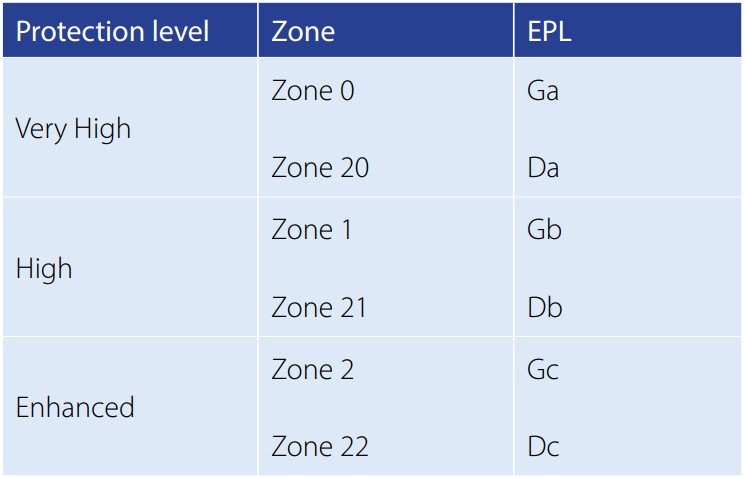
EPL Ga/Da: Equipment having a very high level of protection, which will not act as a source of ignition in normal operation, expected faults or when subject to rare faults.
EPL Gb/Db: Equipment having a high level of protection, which will not act as a source of ignition in normal operation or during expected faults.
EPL Gc/Dc: Equipment having an enhanced level of protection which will not act as a source of ignition in normal operation and reduce the likelihood of acting as an ignition source during expected faults, e.g an indicator lamp failure.
Equipment Protection Levels (EPLs)
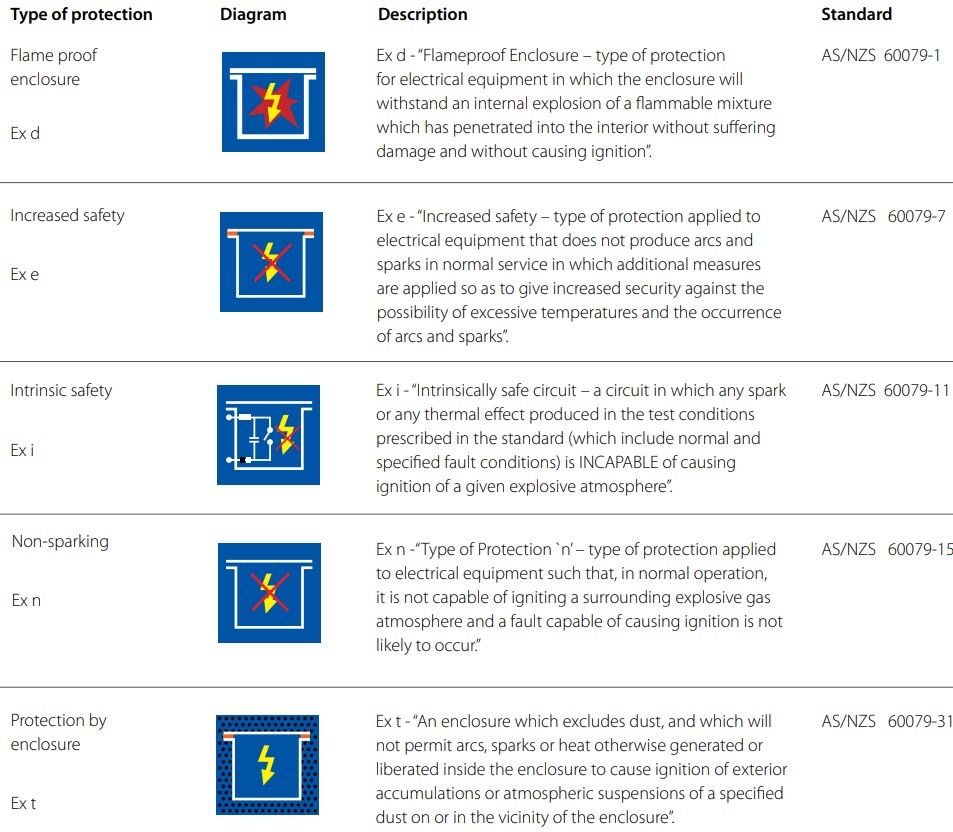
TYPES OF PROTECTION FOR ELECTRICAL APPARATUS IN HAZARDOUS AREAS - EXAMPLES
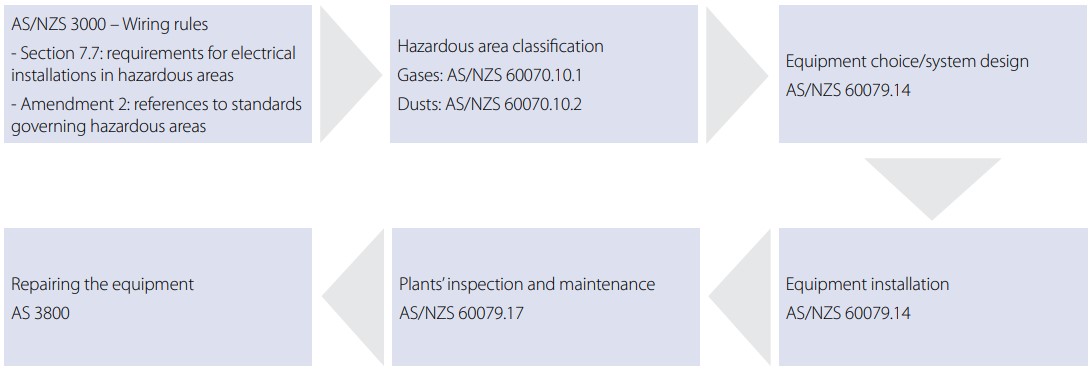
EX HAZARDOUS AREA STANDARDS AND LEGISLATION FLOW CHART
ELECTRICAL LEGISLATION-GENERAL
Within Australian states and territories there is an Act or Regulation of parliament that requires electrical installations to comply with AS/NZS 3000 - Wiring rules. The exact requirements vary State to State, however generally it is the responsibility of the electrical worker or contractor to ensure that the installation complies with regulations (including those referenced in As/NZS 3000). There are serious penalties for non-compliance, including loss of license, fines and jail terms. Although there are often exclusion to the legislated applicability of the wiring rules for places like mines, quarries and petroleum leases, we generally find in such cases that the rules are called up in site safety management plans or contract documents, so compliance is still required, just via a slightly different mechanism.
Section 7.7 of AS/NZS 3000:2007 sets out the requirements for electrical installation in hazardous areas. AS/NZS 3000:2007 Amendment 2 requires compliance with these “harmonized” standards, the AS/NZS 60079 series.
The relevant clauses of Amendment 2 are reproduced below with some added commentary.
RESPONSIBILITY FOR CLASSIFICATION OF A HAZARDOUS AREA
AS/NZS 3000:2007 - 7.7.2.1
The responsibility for classification of a hazardous area rests with the persons or parties in control of the installation. The requirements are contained in AS/NZS 60079.10.1 for gas or vapor and AS/NZS 60079.10.2 for combustible dust.
Commentary: The critical take-away from the above, is the acknowledgment of responsibility that rests with the owner or occupier of the premises that houses the hazardous area in question – a responsibility that is consistent with standard OHS legislation. While this person is not expected to perform the classification itself, he/she is obligated to identify the potential for a hazardous area and engage a competent person (see page 7 for further explanation of competency requirements) to do so.
ELECTRICAL EQUIPMENT
Selection
AS/NZS 3000:2007 - 7.7.2.4.1
Electrical equipment selected for use in hazardous areas shall comply with the appropriate requirements as specified in AS/NZS 60079.14.
Installation
AS/NZS 3000:2007 - 7.7.2.4.2 Electrical equipment shall be installed in accordance with the installation requirements of AS/NZS 60079.14.
Commentary: What is essential to understand here, is that to comply with AS/NZS 3000:2007, electrical equipment that is selected and installed in a hazardous area environment must be compliant to AS/NZS 60079.14.
COMPETENCY OF PERSONNEL
AS/NZS 3000: 7.7.2.4.2
Refers to competency requirements in AS/NZS 60079.14. The relevant clause in that standard is 4.4, reproduced below:
AS/NZS 60079.14 – 4.4
The design of the installation, the selection of equipment and the erection covered by this standard shall be carried out only by persons whose training has included instruction on the various types of protection and installation practices, relevant rules and regulations and on the general principles of area classification. The competency of the person shall be relevant to the type of work to be undertaken. Appropriate continuing education or training shall be undertaken by the personnel on a regular basis.
Competency may be demonstrated in accordance with AS/NZS 4761, Competencies for working with electrical equipment for hazardous areas (EEHA), or equivalent training and assessment framework.”
Commentary: Without exception, persons who intend to work with EEHA are to be appropriately competent to a level that is relevant to the particular works that are being undertaken – regardless of its position in the project cycle. In essence, whether a person is involved in the design, installation or maintenance stage, they must be able to demonstrate competency to ensure utmost safety measures are ensured. It is also important to note that as standards and regulations change and the various technologies involved advance, it is expected that persons continue to educate themselves to maintain their competency levels.
NHP MAKE HAZARDOUS AREAS EASIER…
At NHP our aim is to provide a world class range of hazardous area solutions for the hazardous market and to ensure this is the case, we provide a range of value-add tools for our customers. From product selection through to expert advice, NHP make engineering a solution that meets your requirements easier than ever before.
For your next HAE project, experience the NHP difference.
Hazardous Area Training
To ensure you and your colleagues are competent in working within Hazardous Areas, NHP also offer a range of training packages from ‘lunch and learn’ sessions to single day tailored awareness courses, and 5 day training courses with nationally recognised competencies. With the flexibility to offer courses both on site and at one of our 50+ branch locations throughout Australia, you can trust NHP to work with you to find a training option that works for you.
IECEx certified Hazardous Area Workshop
NHP supplies not only a range of hazardous area equipment, but equally important, customer specific systems via our certified manufacturing and assembly workshop located at Laverton. In this workshop, accredited staff design, construct and inspect the Cortem range according to the requirements of IECEx certification. This allows for flexibility to produce custom solutions to suit your HAE requirements.
NHP Training University (NTU)
If you want to increase your skill set but avoid lengthy lectures and the cost of further education, NTU (NHP Training University) is for you! With valuable training modules introduced regularly, NTU is FREE and designed to further your key industry knowledge.
The latest module looks at Hazardous Area Equipment and explains the basic principle of explosion protection from zone classification and explosion groups, to temperature classes and the different types of protection available.
HAE Technology Specialist Team
Our Hazardous Area specialists have the experience and knowledge to apply HAE best practice across a broad range of industries including Food Manufacturing, Grain, Oil and Gas. The NHP Ex team have the ‘know how’ to develop and recommend solutions that provide value to our customers utilising NHP’s ability to offer complete IEC Ex solutions delivered in industry best time frames.
If you’d like to speak to NHP’s HAE Technology Specialist Team, simply call 1300 NHP NHP (Australia) or 0800 NHP NHP (New Zealand).